
Reading as Practice:
The Word Nature, Lalla (cosmic mother ), and the Fifth State

A teaching from inside the Turiya-Atit Kriya for Awakening
A note before you begin: this one is long, and as you settle in, you may find it easier to tap the audio player at the top of the Substack app and let yourself be read to — the writing is the kind of writing that opens more naturally when you can close your eyes for parts of it.
A note up front, because this post is asking for a slower kind of reading than the platform usually invites. I’m writing this on Mother’s Day, and I want to begin by honoring all the mothers — the ones in our families, the ones who raised us in any form, the ones who have carried the lineages of care across generations — and beneath all of them the Great Cosmic Mother, the Adi Shakti, the original creative power who births every form and dissolves it back into herself. Turiya-atit,the state this whole post is circling, is in one sense the direct meeting with Her — the moment the apparatus of separate selfhood drops and what remains is the field that gives birth to and reabsorbs every appearance. It is not coincidence that the visionary women I write about below — Lalla, Gargi, Akka Mahadevi — are the ones who most directly transmit this recognition. So today, of all days, feels like the right day to be writing this. What follows combines some personal reflection — what I’ve been reading, what I keep noticing in the cat’s lap at the end of a day — with material from a recent class I taught, which itself was sitting inside a larger arc: the practice this season is the Turiya-Atit Kriya for Awakening,given by my teacher Yogi Amandeep Singh on April 29, 2026. I’m writing from inside the practice. Doing the kriya daily. Reading deeply into the poems Amandeep gave alongside it. I’m not reproducing his poems or his kriya here — those remain his to transmit, and the lineage is best received in his own words, in the room with him. What I am doing here is something else, but adjacent: the deconditioning work that the kriya makes possible, in the form of writing.
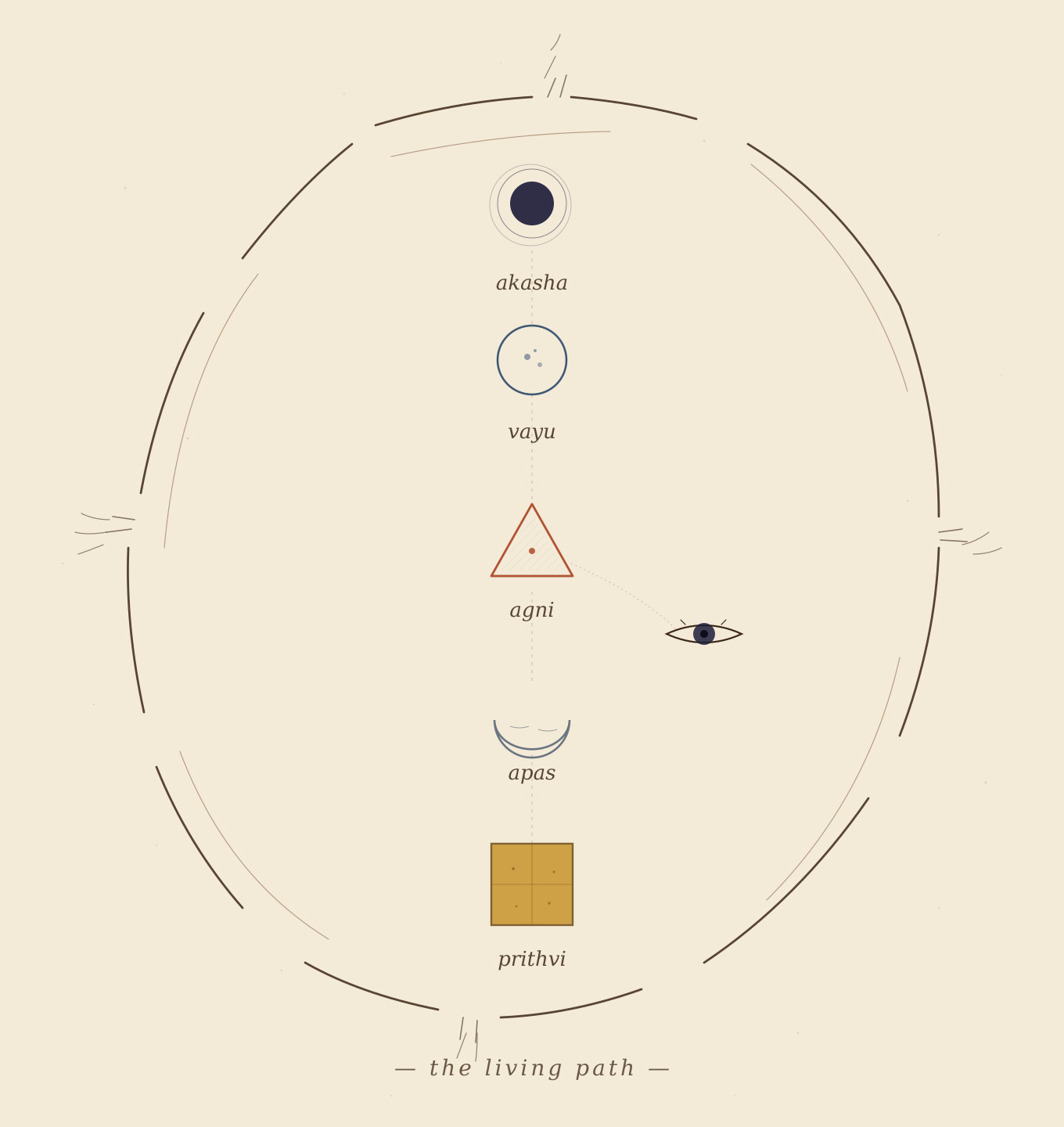
That’s worth a moment to explain, because turiya-atit is the name for what it points to. Turiya is the witnessing consciousness, the fourth state behind waking, dreaming, and deep sleep — the I that watches. Turiya-atit is beyond even that — the dissolution of the witness-witnessed structure itself, the state in which the very subject-object scaffolding collapses, in which one is no longer merely a human being looking at a world but something prior to that whole arrangement. The kriya is a method for inviting that recognition. But here is what doesn’t always get said clearly: a kriya, by itself, can run up against the conditioning the practitioner is wearing. The conditioning is the very apparatus that holds self and world in their separate boxes. If you sit a kriya whose deepest aim is the dissolution of subject and object while your conceptual world is still divided into me on the inside and nature on the outside, the practice meets a wall — not in the body, but in the words. The words you have inherited are quietly doing the metaphysics the practice is trying to undo.
This is why a teaching like this one — which is not the kriya, but the discourse around it — is part of how I work. The kriyas come from the lineage; I don’t make them. What I bring to the transmission is the slow loosening of the conditioning that the kriya, on its own, runs into. So when I spend the first several pages of this post on a single English word — nature — and what it has been doing inside us without our noticing, I am not digressing from the teaching. I am doing the teaching. Every layer of conditioning that gets noticed is a layer the practice no longer has to climb over. Turiya-atit removes us from the idea that we are merely a human being. But before it can do that fully, the structures that build the merely — including the words that build separation between us and the field we already are — have to come into view long enough that we can stop unconsciously rebuilding them.
So: take your time with this. There is a lot here, and it is not built for skim. The form of the writing is part of the form of the practice. If you find yourself slowed, mildly destabilized, gently caught at noticing something you had not noticed — that is the work, not the post going off the rails. Sit with it. The argument will hold while you breathe.
I’ve made it a practice in the evenings to sit with one of my cats and read nondual texts for about half an hour or an hour. Then when I finally settle into the sack, I try to read something pleasurable rather than analytical — letting the day soften at the edges before sleep.
Recently I finished Stanisław Lem’s Solaris, which is one of those books that pretends to be science fiction and is really a metaphysical encounter wearing the costume of one. Now I’m working through In the Same Light from Song Cave — Wong May’s translations of the Tang Dynasty poets, the migrants and exiles of that era — Du Fu, Li Bai, Wang Wei, and others less familiar in English. I love these poets, the so-called nature poets of that period, though that phrase already drags its own conceptual weight in behind it.
Around the same time I’ve been reading work by my friend Karl Kempton, the visual poet and language artist, on iconographic painting traditions — and I’ve been thinking about a ceremony I was once able to attend with the painter Jimmy Toddy (Beatien Yazz, Diné). And there is, to my eye, a strange nearness between Tang Chan-adjacent poetics and certain Indigenous iconographic forms. Not visually — conceptually. They both seem to refuse a particular move that English makes almost involuntarily: the move where the world gets pushed across the room so you can look at it.
Kempton, and a relative of mine I recently heard speak, both touched on the fact that many Indigenous languages don’t carry a word that quite maps onto the English nature. I want to be careful here, because that claim gets repeated loosely sometimes, so let me put it the way that actually holds up: it isn’t that people in these languages fail to recognize trees or rivers or weather or animals (obviously). It’s that the abstraction nature — singular, totalizing, set off from the human — doesn’t lift cleanly out of those grammars. Land, beings, weather, ancestors, kin — they tend to show up relationally rather than as members of one big bucket called The Natural World.
Sheila Watt-Cloutier, the Inuk environmental and human rights advocate, says it directly in her essay “No Word for Nature” in Where the Leaves Fall:
In our language we have no word for “nature”, despite our deep affinity with the land, which teaches us how to live in harmony with the natural world. The division the western world likes to make between humankind and nature is in the traditional Inuit view both foreign and dangerous... By contrast, Inuit place themselves within, not apart from, nature. This “in-ness” is perfectly symbolised in our traditional dwellings of the past: illuvigait (snow houses) in winter and tupiit (sealskin tents) in summer.
Read that in-ness slowly. The dwellings themselves are the teaching — a snow house is not a shelter from the snow; it is the snow gathered around the body, the weather and the body sharing a single substance. The architecture is the metaphysics. Watt-Cloutier is reporting from inside a living grammar that never made the cut English made, the cut into observer and observed.
Closer to home for me, my tribal cousin Jeffery U. Darensbourg — Atakapa-Ishak, like me — wrote a piece in Southern Cultures called “Hunting Memories of the Grass Things,” which I recommend to you on its own terms. The Ishak word for bison is šokon, “grass thing.” And the philosophical move Jeffery makes near the end of the piece is one I want to bring forward, because it pushes past where most of the conversation about Indigenous knowledge tends to stop. He writes, of the Ishak hunting traditions that no longer exist in continuous form:
If we Ishak cannot access much of our historical bison hunting culture, perhaps we can create it anew. That culture would be just as Ishak as what came before, because it would be created by Ishak people, and whatever we create is Ishak culture. It is important to avoid the colonial mindset that the “real Indians” are the dead ones. It is important to avoid the mindset that our culture is static, a museum piece.
This is the move I want to underline. There is a familiar register in which decolonization becomes a kind of grief about what was lost, and the original ways are spoken of as if they belong only to a past that has closed. Jeffery is refusing that. The Ishak are here. What the Ishak do now is Ishak. The original way is not behind us; it is what we are doing today, with whatever materials are present, in whatever bodies are present, on whatever land is present. That is not nostalgia. That is not reconstruction. It is continuity. The “in-ness” Watt-Cloutier names in Inuit life is not a relic locked in a 1950s photograph; it is what is happening, right now, in any body that has not been entirely talked out of the field it has never left. The grammar of belonging is older than the grammar of separation, and it doesn’t go anywhere just because another grammar got loud.
There is a related point Jeffery returns to in his work, which I want to lift up here because today, of all days, it belongs in this writing. In Ishak, the word for the Sun is O’tsatat — and O’tsatat is feminine. The Sun is a goddess. This is not a poetic flourish or a translator’s choice; it is what the language says. The greatest visible power in the sky is named as a She, and addressed as such. Many Indigenous languages of the Americas hold versions of this — the Sun, the Earth, the rivers, the great powers come through gendered grammar that remains in living relation, addressable as Mother, as Grandmother, as the One Who Gives. English, after the natura shift and centuries of grammatical neutering, lost most of this — the sun, the earth, the rain, spoken about rather than spoken to, objects in a sentence rather than persons in a kinship. And what gets registered as loss in English is not just gender — it is the entire grammatical possibility of address. You cannot pray to a neuter abstraction. You can study it. You can manage it. You can enter it. But you cannot meet it as kin.
This is, in a quieter register, exactly what Lalla is doing in the vakhs you’ll read below. You are the heaven and You are the earth. That second-person pronoun — that You — is not decorative. It is the grammar of relation that the natura shift erased and that the visionary women across traditions kept alive. Lalla addressed the Real as Mother and as Beloved. Akka Mahadevi addressed Shiva as Lord-white-as-jasmine, as her direct intimate. Gargi pressed Yajnavalkya past every conceivable answer in the voice of a woman who already knew. And in the lineage I am inside, the Cosmic Mother — the Adi Shakti I named at the opening of this post — is the field itself, the relationality itself, the what-is that births and reabsorbs every form including the form of the seeker. She is not a deity standing at the edge of the cosmos. She is the cosmos in its mode of being addressable. Turiya-atit is, among other things, the dropping of the apparatus that was preventing the address from being mutual. When the witness-witnessed structure dissolves, what remains is not a void but a relation that was never not happening. The Mother addresses Herself in you, as you, through every appearance. O’tsatatshines. The address goes both directions.
I’m naming this on Mother’s Day for the obvious reason but also for the structural one. What we have been calling the Cartesian wall, the natura shift, the grammar of separability — this is, among other things, the loss of the Mother. The loss of the address. The loss of the kinship grammar that knew the sun was a She and the earth a She and the great powers were persons one could meet. Restoring relationality is not a sentimental project. It is the precondition of the very state the kriya is pointing toward. There is no turiya-atit without the dropping of the wall, and there is no dropping of the wall while the language keeps quietly putting it back up. The Mother is on the other side of the wall, as the wall, as the one who never agreed to the wall in the first place. To return to relationality is to return to Her, which is to return to the field that we never actually left.
The etymology of the English word is interesting if you sit with it for a second. Nature comes through Old French from Latin natura, from nasci, “to be born” — originally meaning birth, innate disposition, the essential character of a thing. So far, so fine. The interesting thing is that English already had a word in this neighborhood — the Old English gecynd,which gave us kind, in the sense of “humankind” or “kind of thing.” Gecynd leaned toward kinship, family resemblance, what you belong with. Natura slowly displaced it, and over centuries — especially through the Cartesian turn — naturedrifted into something quite different: a domain over there, a field of objects, something to be observed, classified, managed, occasionally entered. From what you are born into and of to what you stand outside of and study. That’s a real shift. English itself once had the kinship word and traded it for the separation word. The conditioning is right there in the dictionary.
Even the phrase going into nature tells on itself a little, as if one had not been within it the whole time, including the physiological part of us that is already weather and water and bacteria and breath.
None of this is a knock on people who hike or sit under trees or learn birdsong — those are some of the saner things a modern human can do. The point is more that the English noun quietly carries a metaphysics, and it tends to install a small Cartesian wall before the conversation has even begun. And here is where the teaching is doing its actual work, because most of us — even those of us doing serious contemplative practice, even those of us building lives around what we call connection to the land — have organized portions of our existence around the very abstraction we are now noticing. We go to nature on retreats. We return to nature in our writing. We honor nature in our rituals. The word is doing more than describing; it is staging a relation. And the staging keeps separability quietly in place even while we sincerely intend reverence. This is what conditioning looks like when it survives even our reverence. The work of practice is not to abandon the word — there is no abandoning of language — but to see what the word has been doing all along, so that one’s living relation to what the word names is no longer mediated by the unexamined wall.
This is the kind of inquiry I hold for the people I sit with in class. The practice is not just the kriya; the practice is what the kriya makes possible — a kind of looking back at one’s own conditioning that the still mind permits and the busy mind cannot. If the words you’ve inherited are doing metaphysics behind your back, the kriya is one of the few methods by which you get quiet enough to catch them at it.
I was teaching this week, and the moment we got into kriya the fear started coming up for people. Not little fear, not anxiety about the day — the older kind, primary fear, the kind that surfaces when the conditioning starts cracking. And what I said then is what I want to say here, because it’s the same thing.
Almost no society on earth originally had a word for nature. And the reason isn’t quaint or romantic. It’s that there is nothing separate from you out there. The moment you say the word nature, you are saying I am not that. The body wants what it wants — sex, food, sleep, pleasure, rest — and the body wants the wind and the trees and the sun, and that wanting is not crossing some boundary into a different domain. The body, the wind, the trees, the cities, your phone, my cat, the keyboard I’m typing this on — all of it is the five elements in different configurations, different motions. Or if you want to get scientific about it, you could say the periodic table, in different arrangements. Some configurations bring more health to a body, some less. But none of them are outside the body’s belonging.
The fear that comes up in kriya, much of it, is just the conditioning revealing itself. The sense that you are separate from what is. You aren’t. You never were.
In class I read a few poems by Lal Ded — known as Lalla — the fourteenth-century Kashmiri yogini whose verse-sayings, the vakhs, are still recited across Kashmir. My teacher Yogi Amandeep names her as one of three women sages — alongside Gargi, the Vedic interrogator from the Brihadaranyaka Upanishad, and Akka Mahadevi, the twelfth-century Virashaiva poet of Karnataka — who became digambara, sky-clad, dressed in the clouds. The point isn’t the literal nakedness, though that is true of all three. The point is that they had reached a state in which the dropping of all coverings — of memory, identity, story, the inside-outside distinction itself — had become the natural condition. They wore the clouds because there was no longer an outside to put clothes against.
A small word about why I read poems in class, because this matters for understanding what kind of teaching I am offering. In the lineages I have been given — through Yogi Bhajan, and now through Yogi Amandeep — the poems are not decoration. They are the genesis. Yogi Bhajan was a poet, and the lectures he gave were laced with poems, and many of the practices we now call kriyas were originally given as poems and then revealed to function as pranayam, as breath-work, as somatic transmission. The poem comes out of a state of consciousness, and when the poem is recited or sat with, it returns the listener — or the reader — toward that state of consciousness. The poem is a portal, not a description. Amandeep teaches the same way. His own poems, which he gives in the classes, are doing the very work they describe. This is one of the things that distinguishes the lineage I am inside from a more academic encounter with these traditions: the poems are not glosses on the practice; they are the practice, in the form language can take.
Read these slowly. Don’t rush past them looking for meaning. Notice what the syntax is doing — where it leaves off, where it folds back, where it withdraws. The poems are not descriptions of an inner state. They are formal traces of one.
By a way I came, but I went not by the way. While I was yet on the midst of the embankment with its crazy bridges, the day failed for me. I looked within my poke, and not a cowry came to hand (or, atI, was there). What shall I give for the ferry-fee?
— translated by G. Grierson
Read it again, attending to what the verb-tenses are doing. I came — past, completed. I went not by the way — also past, but a different past, a non-arrival inside the arrival. The arrival happens, but the one who arrives doesn’t take the way. This is not figurative. The poem is showing you, in the architecture of its grammar, the structure of an event in which the path is real but the traveler dissolves before the destination. The day failed for me. The light gives out at exactly the moment the search would require it. Not a cowry came to hand. The seeking apparatus comes back empty. What shall I give for the ferry-fee? The poem ends in question, not resolution — because the resolution is not on the side of the question. The traveler arrives without arriving. The way is real; the one who came along it is not.
Passionate, with longing in mine eyes, Searching wide, and seeking nights and days, Lo! I beheld the Truthful One, the Wise, Here in mine own House to fill my gaze.
— translated by R.C. Temple
Notice the structural reversal at the Lo! — the entire first half of the poem is the apparatus of seeking, projected outward across nights and days. Then a single interjection inverts the geometry. The Truthful One was never out there. The seeking itself was the obstruction. Here in mine own House. The form of the poem — outward, outward, outward, then suddenly here — is doing the work of the recognition it describes. The reader experiences in miniature what the poet experienced in vastness: the collapse of distance.
Holy books will disappear, and then only the mystic formula will remain. When the mystic formula departed, naught but mind was left. When the mind disappeared naught was left anywhere, And a voice became merged within the Void.
— translated by G. Grierson
This one is structured as a series of departures, and each line shows the syntax of one further dissolution. Books disappear. Then the formula. Then the mind. Then naught was left anywhere. And at the moment of total absence — a voice. Not silence. A voice. This is critical and easy to miss. The Void is not a blankness. Something speaks from inside it. The poem itself is a sequence of erasures that culminates not in nothing but in address. The dissolution opens into communion. This is what my teacher means when he says, in the slide on the digambara, that “the vastness comes, and the person talks to you.” The vastness is not impersonal. It speaks.
You are the heaven and You are the earth, You are the day and You are the night, You are all pervading air, You are the sacred offering of rice and flowers and of water; You are Yourself all in all, What can I offer You?
Watch what the second-person pronoun is doing across this poem. You are the heaven... You are the earth... You are the day... You are the night... You are all pervading air. The address keeps going outward to greater and greater extents — and yet remains the same address, to the same You. By the time the poem reaches You are the sacred offering, the apparatus of offering has collapsed: there is no separate offerer, no separate gift, no separate recipient. What can I offer You? — not a rhetorical lament but a real structural impossibility, and the poem ends there because there is nothing further to say. The form has eaten itself in the act of praising. This is the syntax of advaita — non-twoness — held in a single grammatical breath.
With a thin rope of untwisted thread Tow I ever my boat o’er the sea. Will God hear the prayers that I have said? Will he safely over carry me? Water in a cup of unbaked clay, Whirling and wasting, my dizzy soul Slowly is filling to melt away. Oh, how fain would I reach my goal.
And then this — which on first read sounds like ordinary spiritual longing, doubt, the prayer of a seeker who isn’t sure she’ll be answered. But look at the imagery. Untwisted thread towing a boat across the sea. Unbaked clay holding water. The instruments of the journey are constitutionally unable to do what they’re being asked to do. The thread cannot tow a boat. The clay cannot hold water. My dizzy soul slowly is filling to melt away. The vessel and what it holds are the same substance — the unbaked clay is being dissolved by the water it was meant to carry. The poem is not lamenting inadequate means. It is showing you, formally, that the seeker dissolves in the seeking, and that this is not a failure but the structure of the arrival. The goal cannot be reached by the one who longs for it, because the one who longs for it is the unbaked clay, and arrival is dissolution. Oh, how fain would I reach my goal. Yes. And the longing itself is what melts the longer.
These are not metaphors illustrating a doctrine. They are formal records of an encounter — visionary syntax, the shape that language takes when it is reporting from inside the dissolution of subject and object rather than describing it from outside.
A brief honest digression, because someone asked me to bring scholarship into the conversation a few weeks back. Tang dynasty poetry — the Wang Wei, Hanshan, Du Fu, Li Bai world — is the subject of an active scholarly dispute about whether it should be read as nondual at all. Yang Jingqing’s The Chan Interpretations of Wang Wei’s Poetry (Brill, 2007) argues that the Buddhist reading is anachronistic, projected backward. Other scholars — Rafal Stepien on Wang Wei’s “imagery of emptiness,” Paul Rouzer on Hanshan, Thomas Mazanec on the Tang poet-monks — argue that the formal traces of contemplative encounter are unmistakably present, and that contemporary Indigenous and Asian language scholarship is destabilizing the older confessional categories. The disagreement is real, and if you have a stake in the historical question, both sides are worth reading. But here is the move I want to offer: the scholarly question of whether a particular Tang poet was a Chan practitioner is a different question from what the poems are doing on the page. A poem that arises out of a state of consciousness — as Yogi Bhajan’s poems did, as Amandeep’s poems do, as Lalla’s vakhs did, as Wang Wei’s quatrains may have — carries the formal trace of that state, and the careful reader can find that trace in the syntax regardless of what we can or cannot prove about the poet’s biography. This is the same position the lineages have always held. The poems are practice. The practice is the genesis. The genesis is what is encoded in the form. Biography matters. The form matters more.
Now, here is where I want to make a move I have been thinking about for a while.
The contemplative traditions I work inside — the Himalayan yogic lineages I have been training in under Yogi Amandeep Singh, the siddha streams that come down through him, and the Atakapa-Ishak and broader Louisiana inheritances I carry through my own family — never made the Cartesian turn. They never split themselves off from the living world in order to study it from across a room. The siddhas, the rishis, the traiteurs, the Indigenous knowers across many continents — these were people who knew what reality was made of by entering it directly, with the body and the breath and the field, without an instrument standing between them and what they were knowing. Lalla didn’t need a confirmation. Gargi didn’t need a confirmation. Akka didn’t need one. They reported from inside the seeing. So did the Ishak who hunted šokonacross the prairies of southwest Louisiana. So do the Inuit who built their snow-dwellings as the weather around their warmth.
The yogic tradition maps the states of consciousness with care. There are four commonly named — jagrat (waking), svapna (dreaming), sushupti (deep sleep), and turiya, the witnessing consciousness behind all three. The Mandukya Upanishad, one of the shortest and most concentrated of the Upanishads, gives this fourfold structure. But Yogi Amandeep, drawing from the Udasin and Raj Yog streams, brings forward a fifth state that the Mandukya itself names but that often gets folded under turiya in popular renderings — turiya-atit, sometimes written turyatita. Beyond even the witness. The dissolution of the witness-witnessed structure itself. The state in which the very subject-object scaffolding collapses into undifferentiated awareness. This is what the kriya he is teaching this season points toward, and it is what these poems by Lalla are formally doing on the page. Turiya-atit was mapped from the inside thousands of years before anyone had the vocabulary of non-separability or quantum information. The map was lived. It wasn’t waiting on confirmation.
A small note on Amandeep specifically, because I want to be honest about how this lineage actually transmits. Amandeep is, among other things, a serious researcher. He was a KRI scholar at one point. And he is unusually clear that his teaching draws from three sources: the lineage he received, his own scholarly research into the actual Vedic, Sufi, Tantric, and Sikh sources behind that lineage, and intuition. He names this openly. This kind of honesty about transmission is, in my view, exactly what the present moment requires. There are aspects of what was given in 1969 — when these teachings began arriving in the West in earnest — that could not, at that time, be transmitted with the full lineage context attached, for reasons of cultural translation and historical circumstance that we can debate but cannot undo. What Amandeep is doing now is, in part, restoring the missing context. Showing where a particular kriya actually comes from. Naming the Sufi couplet behind a familiar mantra. Pointing to the Tantric source of a meditative posture. This is not a debunking. It is a deepening. It is also why I want to be careful in this writing not to flatten or import too directly the specific frames of his teaching — those remain his, and they live in the room. What I bring to my own classes is the deconditioning discourse around them, and the question of whether each of us is in living relation to what we are practicing, or just repeating it.
Which leads me to what I actually want to say next.
It’s almost amusing, if you sit with it long enough, that Western physics — after spending roughly four hundred years insisting reality was made of separate, independently existing objects in separate, independently existing boxes — has in the last few decades begun to stutter toward what these lineages mapped without instruments.
Bell’s Theorem, the careful version: no theory that reproduces quantum predictions can hold onto locality, classical realism, and certain independence assumptions all at once. What that disrupts is the picture of fully separable, self-contained objects sitting in independent local boxes. David Bohm — Oppenheimer’s student, one of the serious figures of twentieth-century physics — called the deeper reality the holomovement, “undivided wholeness in flowing movement,” with the world of separate objects being a derivative surface phenomenon that unfolds from a non-separable whole. Carlo Rovelli, the loop quantum gravity physicist, argues that objects don’t possess intrinsic properties at all — only relations — and has written explicitly about how this resonates with Nāgārjuna’s Madhyamaka. Federico Faggin, the man who designed the first commercial microprocessor, now publishes peer-reviewed papers proposing that consciousness is primary and that quantum information is its substrate. In November of last year, the materials scientist Maria Strømme published a paper in a mainstream physics journal — AIP Advances, Uppsala — literally titled “Universal Consciousness as Foundational Field: A Theoretical Bridge Between Quantum Physics and Non-dual Philosophy.” It was selected as the best paper of the issue.
In class I said this — that what you’re seeing out there is not a chair, not a table, not a fist. It’s particles, or rather, it’s pure quantum potentiality. The wave function does not collapse into the object until there is a conscious observer. And in order for a thing to become an object at all, there has to be an observer. So the object and the observer are not two. They are one interconnected event. Your eyes are creating the world you live in. The eye and the I, as my teacher likes to say, are not separate.
None of this is news to the lineage. The lineage already knew. What’s new is that physics, after four centuries of confidently arranging the furniture of an imaginary separable cosmos, is finally beginning to speak in a register where a Cartesian-trained mind can hear what the siddhas were saying all along. The Inuit knew. The Ishak knew. Lalla knew. Gargi knew.
I want to be clear about which way the catching-up is happening, because the usual move — look, science confirms the mystics — actually keeps physics in the position of the validating authority, with contemplative knowing playing the role of charming local color awaiting Western blessing. That gesture, however well-intentioned, is itself the Cartesian wall in friendly clothing. The honest sentence runs the other way. Direct knowing held the territory first. Physics is the latecomer, and a fairly humble one when you read the actual papers — full of depending on interpretation and this is consistent withand we cannot rule out. The lineage was never tentative. The lineage knew.
There is also a difference, and it matters, between the mathematical articulation and the lived state. Physics can describe non-separability. Turiya-atit is the direct experiential dissolution of separability — not a model of it, not a theory about it, but the thing itself, lived from the inside, with no inside left. The science can go as far as relational non-separability, or consciousness as a foundational field. It cannot go to turiya-atit, because turiya-atit is not a description of reality. It is reality knowing itself without the descriptive apparatus running. That is what the kriya is for. That is what Lalla’s I went not by the way is reporting. That is what the unbaked clay is doing as it dissolves into the water.
Which, oddly, is also what Tang poetry sometimes feels like on the page — not an observer reporting on a world, but participation briefly noticing itself and writing it down before the noticing closes again. A poem in this mode is doing what physics is now stuttering toward: refusing the wall.
So here is the question I want to leave you with, because this is, in the end, what the Living Path is asking. Are you robotically repeating the teachings — the kriyas, the mantras, the ideas, the words like nature, the words like consciousness, the words like practice — or are you holding them in living understanding? The lineage is not the past. The lineage is what is happening now in a body that is in living relation to what was given. A teaching that is repeated without inquiry begins to function exactly like the word nature did in the Cartesian shift: a stable abstraction held in front of the real, so that the real does not have to be met. The Living Path, as I am beginning to understand it and beginning to name it, is the practice of refusing that. Of meeting the teaching, and the kriya, and the word, and the world, again, today, with whatever body is here.
A cat. A book. The slow dissolving of the edge between attention and what attention rests on. Evening thoughts.
A small note before I close. This Substack has been quietly shifting, and I want to name the shift rather than let it happen without acknowledgment. I’m incrementally moving the work here under the name The Living Path: Nonduality, Kundalini, and Poetry — a more honest container for what I’m actually doing across teaching, writing, and lineage practice. As part of that, I’m beginning to post on Thursdays — Guru day — starting with the first Thursday after the coming new moon. The new moon falls on May 16; the first Thursday after is May 21. That will be the first post in the new rhythm.
The Living Path is, fittingly, evolving. I have been told by my own teachers that the work asks for spontaneity, and so the rhythm here may shift as it needs to. That’s part of what living means in Living Path.
If any of this is calling to you and you’d like to sit with it in practice rather than only in reading, I currently teach Presence and Inquiry on Saturdays, 9–11am Central, by Zoom, and co-teach with Taj Chander on Tuesdays at 7pm Central. If you’d like to join, write to me at giannavjeet@ubukundalini.yoga or visit www.ubukundalini.yoga. The classes are open. The work happens together.
If you’re already here, thank you for being here. The work is the same work. The container is just being made a little truer to what it always was.
— Gian